Transforming ideas into impactful publications.
angela burt
Transforming ideas into impactful publications.


Angela Burt teaches religion and philosophy at Australian Catholic University. She is the Project Manager for the ISKCON Oral History Project, Series Editor for the Bhaktivedanta Institute for Higher Studies/Bhaktivedanta Book Trust monograph series, and Co-Organizer for the Vaishnava Advanced Studies (VAST) online conference. She holds
Angela Burt teaches religion and philosophy at Australian Catholic University. She is the Project Manager for the ISKCON Oral History Project, Series Editor for the Bhaktivedanta Institute for Higher Studies/Bhaktivedanta Book Trust monograph series, and Co-Organizer for the Vaishnava Advanced Studies (VAST) online conference. She holds a PhD in religious studies from the University of Leeds. Her research focusses on organisational dynamics and leadership in ISKCON and the broader Hare Krishna movement.
Burt, Angela. 2024. Leading the Hare Krishna Movement: The Crisis of Succession in The International Society for Krishna Consciousness. Routledge.
Burt, Angela. 2023. Hare Krishna in the Twenty-First Century. Cambridge University Press.
Burt, Angela. 2025. ISKCON, Religious Minorities Online, De Gruyter.
Burt, Angela. 2024. Hare Krishna in the Twenty-First Century, ISKCON Communications Journal, 15.
Burt, Angela. 2024. Bochasanwasi Akshar Purushottam Swaminarayan Sanstha (BAPS), World Religions and Spirituality Project (WRSP), https://wrldrels.org/2024/09/29/bochasanwasi-akshar-purushottam-swaminarayan-sanstha-baps/.
Burt, Angela. 2020. An Uncertain Future: The Crisis of Succession in the International Society for Krishna Consciousness. In K. Knott, M. Francis, eds. Innovation, Violence and Paralysis: How do Minority Religions Cope with Uncertainty? Farnham: Ashgate.
Burt, Angela. 2016. The History of a Movement, ISKCON Communications Global.
Burt, Angela. 2015. Transcendent Being or Fallible Human? In Search of the Authentic Guru in the Gaudiya Vaishnava Tradition. Sufi Journal, Summer.
024. Review of Bringing Krishna Back to India: Global and Local Networks in a Hare Krishna Temple in Mumbai by Claire C. Robison, Journal of Vaishnava Studies, 33(1).
Burt, Angela. 2024. Krishnamacharya on Kundalini: The Origins and Coherence of His Position, by Simon Atkinson. International Journal for the Study of New Religions, 12(2), 269-271. https://doi.org/10.1558/ijsnr.28838
Burt, Angela. 2019. Review of Seven Days of Nectar: Contemporary Oral Performance of the Bhagavatapurana by McComas Taylor. Numen, 66 (1).
Burt, Angela. 2018. Review of The Head Beneath the Altar: Hindu Mythology and the Critique of Sacrifice by Brian Collins. Alternative Spirituality and Religion Review, 9 (1).
Burt, Angela. 2016. Review of Jainism: A Guide for the Perplexed by Sherry Fohr. Alternative Spirituality and Religion Review, 7 (1), pp. 337-338.
Burt, Angela. 2016. Review of Hinduism and the 1960s: The Rise of a Counter-culture by Paul Oliver. Journal of Religious History, 4 (1), pp. 135-137.

The Hare Krishna movement is a modern manifestation of the Gaudiya Vaishnava tradition, which has its roots in sixteenth century West Bengal, India. The tradition was institutionalized in a modern form when it was registered as the International Society for Krishna Consciousness (ISKCON) in New York City in 1966 by A. C. Bhaktivedanta Swami Prabhupada. Its mission was to present bhakti-yoga (the yoga of devotion) to a Western audience. This Element introduces the historical origins of the movement and examines its beliefs and practices within the context of its institutional and community dynamics. It also considers the Hare Krishna movement's changing relationship with mainstream society and its shifting demographic makeup in tandem with key challenges and controversies that have beset the movement throughout its history. The Element concludes by considering how the movement's responses to a new set of issues and challenges are pivotal for its future direction in the twenty-first century..
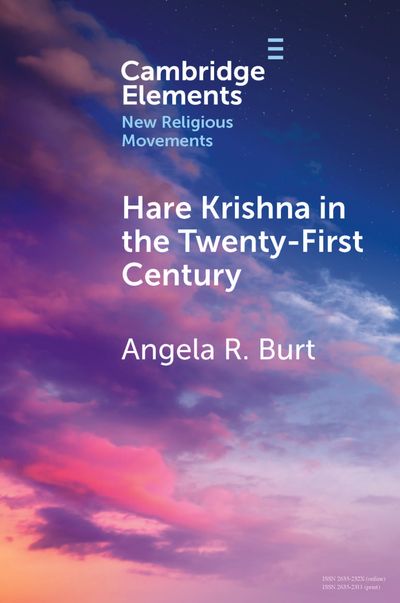
The Elements in New Religious Movements (NRMs) series published by Cambridge
University Press are useful for researchers and students alike, as they are compact,
well-researched and clearly written, and have a contemporary focus. Angela Burt’s
study of the International Society for Krishna Consciousness (ISKCON) has five
chapters (including an Introduction and Conclusion); this review will address each
chapter in turn.
“Introduction and Historical Origins of the Hare Krishna Movement” opens the
book with a historical sketch of the Gaudiya Vaishnava tradition from Chaitanya in the
early sixteenth century to A. C. Bhaktivedanta Swami (1896-1977), who brought
devotion to Krishna to the United States in 1965. The issue of whether to classify
ISKCON as a NRM, as opposed to a part of “Hinduism” (a problematic Western-
originated term that nevertheless designates a “world religion” in the twenty-first
century) and the essentially transnational nature of its development, are briefly
touched upon. Burt also provides a short review of scholarship on the group and
methodological lenses that may be applied fruitfully, including Rodney Stark on
conditions required for a religious movement to succeed, and David Bromley and
Gordon Melton’s ideas about alignment processes.
Chapter 2, “Beliefs and Practices” covers living in temple environs, taking guidance
from a guru, studying Srila Praphupada’s books, mission, diet, marriage and family,
pilgrimage, retreats, and festivals. Chapter 3, “Institutional and Community Dynamics,”
discusses the structure of ISKCON, with its Governing Body Commission (GBC), the
Bhaktivedanta Book Trust which issues ISKCON publications, and temple presidents
at each temple. The ebb and flow of devotees between the West and India is noted and
temples in Vrindavan and Mayapura remain focal points for ISKCON in India, and
international pilgrims. ISKCON was initially Western in membership, but has over the
decades increasingly acquired Indian members and come closer to mainstream
Hinduism in orientation. Burt is careful to explain that ISKCON membership is a
formal status and a larger community that identifies as Gaudiya Vaishnava exists, withthe assemblage of all being “the Hare Krishna movement” (p. 30). This section also
discusses of the exit of members from the mid-1980s onwards to other Gaudiya
Vaishnava groups, mostly, and the scandals concerning Kirtanananda Swami (b. Keith
Ham 1937-2011) or Bhaktipāda, who was expelled from ISKCON in 1987 and avoided
a conspiracy to murder charge, but “was convicted of racketeering and mail fraud
violations in 1993” (p. 31). Schisms are covered, and the fascinating ISKCON Revival
Movement, which aims to replace ISKCON’s management with a new structure that
acknowledges only Srila Prabhupada as initiating guru, is especially interesting.
Multiple shifts from monastic to congregational life and from Western to Indian
congregants, the development of an online presence and from street proselytization
to varied modes of outreach, through restaurants, retreats, yoga centres, and festivals
are canvassed. Today, there is less emphasis on wearing robes and having shaven heads,
yet some things are constants: literature “remains a core proselytization practice” (p.
42) and a range of teaching and research institutions contribute to members’
education.
Chapter 4, “Issues, Controversies, and Challenges,” is a study of various things that
have made ISKCON controversial since its inception in the 1960s, such as the ‘cult
controversy’ accusations of brainwashing and mind control in the 1970s, especially in
America, and state persecution in the Soviet Union from around 1980. The
contemporary Russian Federation is determinedly against ISKCON, too, claiming that
members are religious extremists and that the group itself is a “demonically oriented
religion” and a “totalitarian cult” (p. 50). Burt discusses a range of legal disputes, from
cases restricting book distribution as an activity in the United States, through the
successful United Kingdom campaign to keep Bhaktivedanta Manor open as a worship
space, to cases concerning child abuse in ISKCON. These are outward-facing disputes
with host societies. There are also internal disputes, importantly about succession and
“institutionalized child abuse,” which she terms “one of [ISKCON’s] darkest secrets”
(p. 55). Attention is also devoted to the theological question of the origin of the soul;
in 1995 the GBC pronounced in favour of Prabhupada’s expressed view that the soul
“falls down into the material world” after rejecting a personal relationship with Krishna
in the spiritual realm (p. 56). A controversial book, In Vaikuntha Not Even the Leaves
Fall (2019) was banned and one of its authors, Satyanarayana Dasa, left ISKCON to
found the Jiva Institute in Vrindavan. This controversy feeds a current of thought that
Prabhupada often expressed views that were “offensive to various groups including
women, people of various nations and races, members of the LGBTQI community,
scholars, scientists, and other Gaudiya Vaishnava groups” (p. 57). Controversy still
exists over the editing of Prabhupada’s books and the moves since the 1990s to allow
women to take prominent roles in ISKCON are similarly polarising. ISKCON in India
is usually the strongest conservative voice, so a new group, Krishna West, was established in 2014 by Hridayananda das Goswami; this group operates within
ISKCON and strongly pushes a Western identity for the movement, opposing the
Hinduisatn and Indianisation of the religion. Burt covers debates about LGBTQ+
members, the rise of veganism, and the Covid-19 pandemic, contrasting the
conservatism of early ISKCON with attempts to be more inclusive and in line with
changes in host societies.
Chapter 5 provides a short conclusion to the book, which has a summary of
contents, a reiteration of the value of frame alignment and resource mobilization
theory as lenses through which to analyse ISKCON, and stresses again Burke
Rochford’s view that the success of ISKCON depends on the path it commits to in “a
rapidly changing world” (p. 69). There is a comprehensive list of references at the end,
which will be of great use to students studying the history and sociology of Krishna
Consciousness. Angela Burt has produced a pithy, wide-ranging, and relevant book on
ISKCON for this series, and is to be congratulated. I recommend it to all interested in
NRMs, Indian religion, transnational movements, and the sociology of the
contemporary world. It is a must for the libraries of educational institutions.
The Cambridge Elements series aims to present relatively short but
comprehensive overviews of specific topics across academia. They are
available both print and online, and intended for the reference and
student market. The late scholar James R. Lewis led the initial efforts to create208
Journal of Vaishnava Studies
a new religious movements booklist within the Elements, and this series-with-
in-a-series is now edited by Rebecca Moore, book reviews editor and former
co-general editor of Nova Religio: The Journal of Alternative and Emergent Religions.
The new religious movements series of Cambridge Elements, now numbering
approximately twelve titles, is a well-respected but relatively new entry into
the genre of slim comprehensive reference books, alongside such other series
as Oxford University Press’s Very Short Introductions and Routledge’s Basics.
Angela R. Burt’s Hare Krishna in the Twenty-First Century is one of these new
Elements books, and from the outset it should be contextualized within the
series: the book is intended as both an introduction and as well as a com-
prehensive treatment of the Hare Krishna movement, and is written for
students, researchers who are new to the topic, and other reference readers.
Specialists in the study of ISKCON and certainly devotees themselves are not
the primary audience of the book, but they will still find it to be a helpful one,
especially in terms of how the author theorizes the topic. Although the book
does not draw from new empirical research in the sense that a full-length
monograph does, it is informed by the author’s ethnographic experience and
involvement in the global ISKCON Oral History Project. Burt also offers a the-
oretical model of the growth and transformation of ISKCON. The book should
be read as a scholarly contribution, and not simply a reference book.
Hare Krishna in the Twenty-First Century is organized into five chapters: an
introduction, which also includes the history of the origin of ISKCON; beliefs
& practices; social dynamics; controversies & challenges; and a brief conclu-
sion. Burt employs several theoretical models to understand the movement.
First, she argues that ISKCON can be situated within sociologist of religion
Rodney Stark’s model of conditions for religious movement success.1 Stark’s
approach calls for attention to the degree of tension in the relationship
between a religion and broader society, in keeping with the rational choice
model of the sociology of religion that Stark championed, alongside Roger
Finke, William Sims Bainbridge, and others.2 As Burt argues, “the challenge
for the Hare Krishna movement is to adapt to a rapidly changing world while
remaining true to the core values unique to its religious tradition: in Stark’s
words, to offer a religious culture that sets it apart from the general, secular
culture, to be distinctive, and impose relatively strict moral standards while
maintaining a medium level of tension.”3 Successful religious movements
position themselves as unique, but not so unique that the social cost of mem-
bership is prohibitive.Book Reviews 209 209
Burt’s second theoretical approach, frame alignment theory, examines
how adherents align themselves within ISKCON, and by extension how
ISKCON aligns itself with surrounding culture, i.e., what frame alignment
regards as “host societies.” Under this model, the Hare Krishna movement
offers a specific set of “frames” by which a devotee or potential devotee can
understand the world, “to identify and label occurrences they encounter
and thereby render them meaningful,” as Burt explains.4 Frames are essen-
tially social-spiritual worldviews or ideologies. The process of becoming a
devotee involves aligning oneself within these frames, but the Hare Krishna
movement itself can also be studied by considering how its central operative
frames align (or not) with its host societies. Both Rochford and Zeller have
previously used frame alignment to study ISKCON, but Burt extends it here.5
She shows how the movement’s earlier alignment with the global countercul-
ture, and lack of continuity with the majority culture, gave way to attempts to
realignment. Burt also considers the fraught and contentious nature of such
realignment.
The book also draws on resource mobilization theory — which seeks
to understand how the Hare Krishna movement and ISKCON as a formal
institution utilize human and non-human assets. Burt’s history of ISKCON,
for example, highlights institutionalization efforts such as the origin of the
Governing Body Commission (GBC), temple presidencies, the Bhaktivedanta
Book Trust (BBT), and other management institutions. In keeping with Tra-
vis Vande Berg and Fred Kniss’s work on ISKCON and immigration,6 Burt
emphasizes transnational flow as central to the mobilization of the human
resources of ISKCON, which she identifies both in the travels of Prabhupada
and the early ISKCON missionaries as well as today. These three theoretical
lenses provide the foundation for the book’s introduction to the Hare Krishna
movement.
The first chapter provides an overview of the movement’s history, rooting
ISKCON in the Gaudiya Vaishnava tradition, and the lineage of Bhaktivinoda
Thakura (1838–1914) and Bhaktisiddhanta Sarasvati Thakura (1874–1937) to
A. C. Bhaktivedanta Swami Prabhupada (1896–1977), and the legal and institu-
tional formation of ISKCON in 1966. The first chapter also includes a literature
review of previous studies of Krishna Consciousness. Finally, it considers the
classification question of ISKCON, noting that some adherents eschew iden-
tification with the category of Hinduism and some embrace it. Burt does not
take a position. She does situate ISKCON within the category of “new religious210
Journal of Vaishnava Studies
movement,” concurring with Kim Knott, J. Gordon Melton, and Malcolm Had-
don that the movement must be situated in mid-twentieth century cultural
and social developments.7 “A key theme running throughout this Element is
the idea that the Hare Krishna movement can be simultaneously thought of
as the continuation of a 500-year-old religious tradition and a new religious
movement, although, as the movement ages, the label becomes less appli-
cable,” argues Burt.8
The second chapter of the book, on beliefs and practices, provides a good
overview of bhakti yoga for those outside the tradition. In addition to detailing
the major theological positions (monotheism, devotion, etc.), Burt emphasiz-
es the role of the guru and the parampara lineage of gurus, and their relation
to the Vaishnava textual tradition. Burt’s explanation of “the centrality of the
guru within ISKCON” will be helpful to readers unfamiliar with either ISKCON
or broader South Asian traditions, and who understand the concept of guru
only from a commodified and secularized perspective.9 Burt also provides an
overview of temple service, major holidays, pilgrimage sites, and other reli-
gious practices. Although Burt identifies her approach as following the lived
religion school of emphasizing the lives of adherents rather than the formal
institutions to which they belong, much of the chapter focuses on institu-
tional ISKCON, which is both a strength (for readers unfamiliar with ISKCON),
and a weakness (for specialists hoping to see greater attention to lived expe-
riences drawing on the author’s ethnographic and oral history data). Still, I
appreciated Burt’s treatment of new developments such as spiritual retreats,
which as Burt argues have become increasingly popular in tandem with the
increase in congregational membership.
Chapter three covers the transition in ISKCON from a primarily monastic
and temple-oriented movement to a householder-based and congregational
one, as well as the involvement of Indian-Hindus and mobilization of trans-
national Hindus as resources for movement success. This will be familiar to
readers of E. Burke Rochford’s scholarship.10 Burt argues that frame align-
ment theory shows how the movement shifted from a world-transforming,
ashram-based, and countercultural one to one affirming foundational tenets
of Western society. Burt cites Nicole Karapanagiotis’s recent study of “Krish-
na branders” and Krishna West as an example of such frame realignment.11
The fourth chapter, on controversies and challenges, covers familiar
ground to both devotees and longtime observers of ISKCON. Burt summarizes
accusations of brainwashing that accompanied the “cult scare” period of theBook Reviews 211 211
American counterculture, as well as legal disputes involving fundraising. The
chapter also details state-sponsored persecution of ISKCON, especially in the
former Soviet Union and Soviet Bloc. It also describes internal challenges,
notably the question of succession (the zonal acharya system, the ritvik con-
troversy, etc.), the guru reform movement, and accusations of child abuse in
the gurukulas. The chapter also includes a treatment of the changing role of
women in ISKCON and controversies over female leadership, including the
debates over the permissibility of female diksha gurus.
The Element concludes with a consideration of ISKCON within the theo-
retical models that Burt uses, especially frame alignment and Stark’s reli-
gious movement success model. Although, as is often noted, historians make
poor prognosticators, Burt does deploy these models to argue that ISKCON’s
future success depends very much on questions of frame alignment. “The
Hare Krishna movement’s future trajectory as a religious movement in the
twenty-first century is largely dependent on decisions about what frames its
members want to align it with. The perception that the movement is evolving
from its original mission of being a global preaching organization to a Hindu
movement will need to be resolved, along with addressing whether both
aspects can be maintained within the same movement.”12
Several sections of the book are worth drawing attention to. Chapter four
includes a treatment of Krishna Consciousness outside of ISKCON, which Burt
subsumes under the sociological category of “believing without belonging.”
This includes splinter movements, lapsed members, ritvik proponents, as
well as reform-minded individuals who have disaffiliated from ISKCON. The
fifth chapter’s treatment of contemporary issues both links to this as well
as expands it, as Burt explores tensions within Krishna Consciousness over
the Krishna West movement, same-sex relationships, women’s leadership,
and political and nationalist disputes between devotees. All this combines
to demonstrate to readers that Krishna Consciousness — like other religious
traditions—exists in diverse ways, and beyond a single institution. As much as
devotee readers may not enjoy reading these sections, they make an impor-
tant sociological point for non-devotee readers. Such readers are aware of
the broad range of religious identities, practices, and beliefs among Jews and
Catholics, for example, and Burt suggests the same is true among Vaishnavas
as well. “The underlying assumption here is that ISKCON is equivalent to its
temples. This assumption does not acknowledge the broader Hare Krishna
movement, which is comprised of a complex network of relationships amongJournal of Vaishnava Studies
212
devotees, many of which take place beyond the purview of its temples and
official ISKCON events and activities,” she argues.13
Another strength of the book is the author’s consideration of contem-
porary issues, such as Hare Krishna institutional and devotee response
to the COVID-19 pandemic, the rise of global right-wing politics, and the
Russian-Ukrainian war. In addition to subsections on each of these, Burt
notes throughout the book how the pandemic and contemporary affairs
have impacted the movement, for example describing “the world’s first digi-
tal Ratha-Yatra across six continents,” but also the rise of conspiricism and
online radicalism within ISKCON internet forums.14 Burt’s excellent history
of the expansion of ISKCON in the former Soviet Bloc leads also to her consid-
eration of how the ongoing war between Russia and Ukraine has introduced
tensions among some Hare Krishna devotees and communities.
There is very little to critique about this book. It accomplishes the goal of
the Element series, namely to offer a comprehensive and concise overview
of the Hare Krishna movement. Burt also, by use of the theoretical lensing of
Stark’s religious success model, frame alignment, and resource mobilization,
offers a new take on ISKCON that marks this book as not only a reference
volume, but offering a scholarly assessment of the movement’s development
and transformation.
Timothy Miller, University of Kansas
The International Society for Krishna Consciousness, often known
as the Hare Krishnas, burst onto the American scene in the mid-1960s
with the arrival of Swami Bhaktivedanta, known to his followers as
Prabhupada. The movement has been extensively studied by scholars,
but after half a century in this country it has slipped away from the con-
troversies it once experienced. Burt, whose scholarship is deep and thor-
ough, recounts the earlier days of the movement, when the members
typically lived communally in temples, and then brings the story up to
date. How did the movement deal with covid-19? What of the child
abuse that several of its leaders committed? How does it deal with its
founder’s writings that today sometimes seem to have distasteful ele-
ments of sexism, racism, and more? Burt also notes that ISKCON itself
has suffered schisms, leading to several new versions of this faith rooted
in ancient India. An excellent book, and a good update for those who
haven’t followed ISKCON’s recent story.
Tilak Sinha-Gröger, University of Sydney
There is a general understanding that of the many New Religious Move-
ments (NRM) emergent from the 1960s milieu, it is only a handful that
have sustained to the current day. Angela R. Burt’s volume in the Ele-
ments in New Religious Movements series published by Cambridge
University Press, provides an insight into the present condition of one
such NRM, the Hare Krishna movement, particularly the International
Society for Krishna Consciousness (ISKCON), as it adapts not only into
the twenty-first century, but into a rapidly shifting new identity in its
endeavour to maintain longevity. Aiming to address “the multitude of
issues facing the movement,” taking “into account major social and cul-
tural upheavals that have taken place since the scholarly analyses of the
early 2000s,” and “[drawing] on recent scholarship” (p. 6), Burt further
addresses several issues in the study of the Hare Krishna movement, not
least of which being the over fixation of American ISKCON members,
neglecting the truly global presence of the movement.
Burt achieves this goal over five chapters: the introductory chap-
ter which situates the founding of ISKCON by Bhaktivedānta Swāmī
Prabhupāda (hereby Prabhupāda) within a brief history of Gauḍīya
Vaiṣṇavism, and also defining Burt’s methodological approach; Chap-
ter 2 giving a concise and engaging insight into the lifestyle and beliefs
experienced by ISKCON members, and how they vary according to
adherent’s demographics; Chapter 3 exploring ISKCON’s sociological
structure; Chapter 4 exploring controversy both externally in terms of
ISKCON within broader society, and internally amongst ISKCON devo-
tees themselves; and the concluding chapter’s compelling prognostica-
tion of ISKCON’s future directions—preceded by a brief book summary
—which will likely be found far-sighted in the coming decades.
Though Burt emphasizes an emic perspective (p. 9)—Chapter 2 looks
at a day in the life of an ISKCON member is vivid and engaging for it
(p. 15–25)—this does not prevent a pithy and compelling methodological
apparatus: her deployment of frame alignment to explore the shifting
Keywords ISKCON, Hare Krishna, Gauḍīya Vaiṣṇavism, New Religious Movements
(NRMs), bhakti, neo-Hinduism contextual pressures which ISKCON inflects to align with proves to be
an incredibly effective extension of Rochford’s (2007) use. Her emphasis
on this shifting nature accounts for why ISKCON has chosen the histori-
cal avenues of permutation that result in its contemporary form; ISK-
CON’s “religious transplant” (Bryant and Ekstrand, 2007) is not only the
initial transplant from India to a global presence, but now also from a
counter-cultural movement to an Indian-Hindu immigrant community
(p. 69). The tensions that these transitions introduce are manoeuvred
elegantly, focusing on them while careful not to over-estimate their
divisive potential (p. 41), and providing concrete instances, such as the
humorous contrast of an ISKCON property divided into an eco-village
and a fracking project (p. 40). Also important is Burt’s noting the role
of Hindutva in these shifting frames (p. 36)—an area that pertinently
requires more attention.
The discussion of controversies in Chapter 4 achieves the goal of shift-
ing away from an overly American focus by providing fascinating dis-
cussion of the ways in which the current Russian invasion of Ukraine has
revealed deep fault-lines in ISKCON’s rapidly growing eastern European
communities (p. 65). Other controversies and schisms, such as accusations
of current ISKCON leader past participation in Kīrtanānanda Swāmī’s
criminal activities, and the various schisms of the Bhaktivedānta Insti-
tute, were understandably not included within the scope of this book.
What is peculiar is the exception of the recent controversies over child
abuse cases against two prominent ISKCON gurus. Supporters and critics
of both men arose, and the ensuing contention resulted in the formal
censure and defrocking of one sannyāsin; the other, after heavy protest
from ISKCON India leadership, was not investigated. This terminated
investigation resulted in a member of ISKCON’s highest level of manage-
ment resigning in protest, and local ISKCON leadership in Europe and
North America banning the accused sannyāsin. Such severe controversy,
undergone in recent history and revealing ISKCON’s international ten-
sions, appears odd to not have been discussed beyond two brief passing
references (p. 55, 72).
Burt’s engagement with the question of ISKCON as a NRM is balanced
and demonstrates the issues with characterizing the Hare Krishna
movement as “new” when contextualized in its Gauḍīya Vaiṣṇava roots
(p. 4–5). At times however, the focus on ISKCON—justified by ISKCON
being the largest Gauḍīya Vaiṣṇava institution (p. 5)—is still narrow
enough to imply rupture where there is none. Prabhupāda is said to have instructed only a small canon in contrast to the Gauḍīya tradition (13),
and while Prabhupāda did emphasise only requiring study of a small
set of books, Prabhupāda also, in his Śrīmad-Bhāgavatam 1.1.1 commen-
tary, encourages reading well beyond even the broad Gauḍīya canon
(1972, p. 50). Further Rūpa Gosvāmin, Gauḍīya Vaiṣṇavism’s intellectual
founder, in Bhakti-rasāmṛta-sindhu 1.1.13 lists “reading too many books”
as a spiritual fault. Attributed to Prabhupāda then is an established
Gauḍīya skepticism towards scholasticism. Furthermore, characteriza-
tion of Prabhupāda’s institutional drive being present “earliest days of
his mission in the United States” (p. 26), while technically correct, does
not reflect Prabhupāda’s prior involvement in founding multiple insti-
tutions in India, with at least one, Gauḍīya Vedānta Samiti, continuing
to today. Prabhupāda’s requesting his preaching to be done within one
schism from his guru’s institution, the Gauḍīya Maṭh, for his original
America trip, and his later requesting the Gauḍīya Maṭh emblem painted
on an ISKCON temple, reflect that Prabhupāda’s institutional drive was
driven significantly from a feeling of continuity with his guru, and not as
a solitary pragmatic event.
These peculiar ISKCON-centric framings extended elsewhere in the
book, as in the discussion of the “Jīva Origin” debate, whose narrative
was based entirely on the writing of Tamal Krishna Goswami: certainly
an academic, but also a highly influential ISKCON manager and guru. The
section presents a version of the debate conducive to official ISKCON
narratives, with the debate becoming between those who base their
views on the writings of earlier Gauḍīya thinkers, and those who draw
their ideas from Prabhupāda, a framing that elides the many ISKCON
individuals (including the controversial and highly charismatic guru
Gour Govinda Swami) who found in Prabhupāda’s books their founda-
tion in rejecting the view finally adopted by the ISKCON institutional
leadership.
Even in light of the critique raised in this review, Burt still stands as
having provided in this book not only a fantastic introduction to the Hare
Krishna movement in the twenty-first century, but also, in her effective
and comprehensive synthesis of the prominent work in the field, a great
entry point for any reader wishing to enter into the broader study of ISK-
CON (The references alone supply a great list for prospective sociologi-
cal study of ISKCON). Its exceptionally accessible style, reflected in even
terms like “Sanskrit” being given explanatory footnotes (p. 2), makes
it appropriate for both under-graduate and post-graduate readers who are interested in ISKCON, NRMs, and Eastern Religions in a modern and
globalised world. Its content would equally be of interest to contempo-
rary Gauḍīya Vaiṣṇava practitioners who would value an academically
reasoned insight into the current condition of ISKCON, the tradition’s
largest formal institution.
This book examines issues of leadership and succession in the International Society for Krishna Consciousness (ISKCON) which was founded in by A. C. Bhaktivedanta Swami Prabhupada in 1966. After the founder’s death in 1977, the movement was led by a group of gurus in a "zonal system" until their authority was challenged and reformed in the mid-1980s. At the heart of the book is an exploration of the developments, conflicts, and defining characteristics of leadership in ISKCON in this decade. Themes of hierarchy, status, power and authority, and the routinisation of charisma are shown to be keys to understanding the events of the time. With careful analysis of interviews and documentary evidence, the research offers a unique insight into ISKCON as an organisation and the broader religious community in which ISKCON is located. The book will be of particular interest to scholars of new religious movements and those concerned with religious leadership.
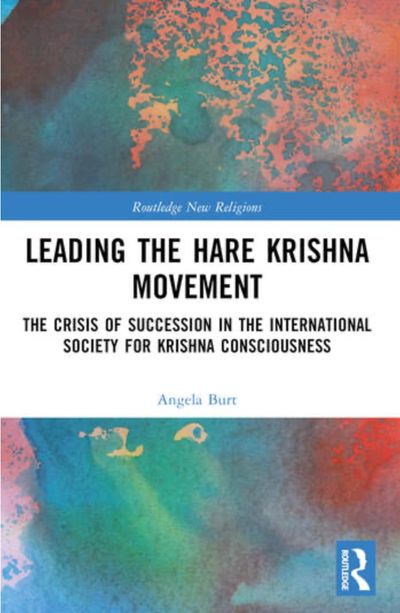
Angela R. Burt’s book is the first comprehensive academic study of ISKCON
that focuses on events during that critical period. The big questions that have
informed her enquiry are: What form did religious leadership in ISKCON
assume after the passing away of the founder, and what were the key features
and effects of that leadership within the institution? The book constitutes a
qualitative study of religious leadership in ISKCON in the period following the
death of its founder—the period that marks a crisis of succession.
The broad methodological approach is historical, and documentary sourc-
es form the backbone of the research. They include ISKCON’s annual GBC
meeting minutes and resolutions, other ISKCON managerial meeting minutes,
GBC position papers, papers written by gurus and the GBC on the position of
the guru in ISKCON, letters by the GBC and individuals, and transcripts of the
final conversations with Prabhupada. The research also involved conducting
semi-structured oral history interviews with people who were members of
ISKCON in the period under study, and also with scholars who had studied
ISKCON in that time. The material also includes newspaper coverage of ISK-
CON leaders who took the position of religious leaders in the institution after
the death of Prabhupada.
The book can be divided into two parts. The first part, chapters 2–5, is
historical and descriptive, and focus on narrating the events in ISKCON from
1977 to 1987 that are at the heart of the succession crisis. They describe reli-
gious leadership in ISKCON, the crisis of succession, the guru reform move-
ment and the experiences of disciples of the successor gurus. Special atten-
tion has been given to women’s experiences since the gurus were all male
and most of the leadership positions were dominated by men. The second
part, chapters 6–8, constitute analytical chapters which discuss the major
issues from thematic and theoretical perspectives.
The essence ISKCON’s difficulties centered on the legitimacy of the spiri-
tual and institutional authority of the eleven disciples of Prabhupada, who
were thought to have been appointed by him to succeed him as gurus. When
the same gurus were assigned geographical areas where they operated as the
sole initiating gurus, there arose an arrangement called the zonal acharya sys-
tem, which implied that the same gurus were also administrative heads of their
respective zones. However, Prabhupada had also set up a governing board, the
Governing Body Commission (GBC) to oversee the management of the entire
organisation. The inevitable question was: what is the relationship of the zonal
acharyas to the GBC? The crisis was precipitated by the increasingly question-
able behavior of some of the gurus. When some of them evidently deviated
from standards expected within the tradition, their authority was seriously
compromised, which brought the entire organization into a deep crisis.230
Journal of Vaishnava Studies
It comes as no surprise that events that took place during this period have
also engendered intense self-scrutiny within the movement that still lingers
on to some extent. Quite a lot has been written on these events, especially
within the movement itself, and Burt’s book doesn’t provide any special rev-
elations in terms of historical detail. It is nevertheless important that the
sequence of events is narrated in detail, looked at from different viewpoints
and carefully documented with multiple sources of reliable information. Burt
has done an admirable job in putting the story together by attending to dif-
ferent voices and viewpoints both within and outside ISKCON. The overall
picture of the various developments is coherent and hard to challenge in
terms of factual information.
But there is a deeper question: what does it all mean? It is especially the
second, analytical part of the book that breaks some new ground and pro-
vides some fresh insights into the broader meaning of the crisis. Unlike many
scholars who have studied ISKCON, Burt does not view ISKCON as a new reli-
gious movement, but rather a new institution that is part of an older tradition. The
change in viewpoint may seem small, but in the case of ISKCON, it helps to
frame the problem in a particularly accurate and fruitful way: the leadership
challenges that beset ISKCON after the death of the founder can be analyzed
as part of the tension produced when a very traditional religious culture is
institutionalised in a modern, global context, especially with the help of mod-
ern institutional structures. In other words, at issue is not just power—and its
possible misuse by unscrupulous individuals, as the “cult” stereotype would
have it—but broader issues such as Indian vs. Western conceptions of author-
ity, sacred vs. secular authority, traditional vs. modern institutions, individual
charisma vs. institutional authority, and so on. While one may doubt some of
Burt’s assessments, the way she frames the questions helps to bring new light
to some very important and real issues.
One could easily make a mistake of imagining ISKCON as simply represent-
ing the traditional, Indian, sacred and charismatic side of these dichotomies.
Burt’s study shows that the reality is much more complicated and nuanced,
and that many of the issues that were to be resolved in the crisis stem pre-
cisely from the fact that Prabhupada himself (and some of his predecessors)
had envisioned an organization that incorporated modern institutions such
as a governing board (the GBC) with democratic decision-making procedures.
In Prabhupada’s vision the GBC would act as the ultimate managing authority
that would ensure that the movement would stay unified after his demise.Book Reviews 231 231
Yet, as Burt’s study shows, the sacred or spiritual authority is still very
much vested in gurus, which is to say, it is vested on tradition and on indi-
vidual charisma. The devotees tend to place their ultimate loyalty on the
gurus rather than an administrative organ, i.e., the GBC. It was thus inevi-
table that at some point these forms of authority came into tension with each
other. This is not to say that such tension is necessarily bad, or even likely to
cause trouble. In the best case, ISKCON may reap the benefits of both types of
authority—stay unified as an international organization under which indi-
vidual charismatic gurus may attract groups of followers. Whether ISKCON
fully succeeds in this, only the future will tell, but the structural issue needs to
be recognized and deeply reflected upon, for otherwise it may turn into a sort
of pathology.
Angela Burt’s book is not only an important addition to the scholarship on
ISKCON, but also a welcome contribution to the more general scholarship on
religious leadership and religious authority under modernity. Furthermore,
it is not only scholarly readership that are likely to find the book interest-
ing and insightful. It is written from a methodological perspective that is
likely to resonate with the experience of ISKCON members themselves. Burt
has delved deeply into the guru-issue within ISKCON and through interview
material she is also able to give voice to people who may not have been on
center stage in the organization’s many power struggles.
Leading the Hare Krishna Movement, based on Angela Burt’s doctoral
thesis, analyzes the succession crisis faced by ISKCON following the
death of its charismatic founder. The struggles will seem familiar to stu-
dents of new religious movements, though the particulars are unique.
As Burt explains, the ailing Prabhupada appointed 11 senior disciples
as gurus to continue initiating new members of ISKCON. Each guru
was responsible for a “zone” which often comprised several nations; the
whole planet was divvied up.
Prabhupada had previously created the GBC, a group of prominent
male disciples (currently 34), to be the major managerial body for all
of ISKCON. However, he failed to specify how the roles of the gurus
and the GBC were to mesh. In the Gaudiya Vaishnava tradition, gurus
have traditionally held absolute power. Only some of the GBC members
were gurus, and several of the most forceful gurus were not on the
GBC. Compounding matters, most senior disciples were neither GBC
members nor gurus.
Initially, the two partially overlapping groups managed the death of
the founder well, providing devotees with a clear sense of continuity.
However, struggles over authority, power, and legitimacy soon arose.
The 11 new initiating gurus began assuming the roles and abso-
lute status of the recently deceased and deeply revered Prabhupada,
much to the chagrin of other long- term devotees who had as much or
more experience and often better scholarly credentials. Some devotees
claimed that the new gurus should be worshipped. Others said they
were simply providing initiations as proxies for the late Prabhupada.
It seems that Prabhupada selected the gurus for their faithful service
and managerial abilities— not remarkable spiritual qualifications— yet
the young gurus were literally worshipped by their disciples. The adula-
tion was more than most could handle. Within a few years three had
“fallen down” (broken one or more of their vows). Burt treats the gurus’
transgressions discreetly. Readers unfamiliar with the lurid details will
want to consult the internet, which should clarify why reforms were es-
sential for the survival of ISKCON.
Meanwhile, the GBC was dominated by the gurus within it, while
also facing conflict with powerful gurus not on the GBC, as it attempted
to provide guidance to the whole movement. Burt describes the many
twists and turns of the succession struggles as they developed over the
following decades. It is a long, complex story with many ins and outs,
compounded by power struggles and turf wars over the “zonal acha-
rya system.” She presents the complex tale in a clear and intelligible
manner— no mean feat.
Steven J. Gelberg
"An extraordinary piece of scholarship"
Loosely speaking, "Leading the Hare Krishna Movement" might qualify as an extended commentary on the notion that “Every religion begins in mysticism and ends in politics” (credited to American Catholic Benedictine monk, Br. David Steindl-Rast). More specifically, it is a masterfully executed, scholarly study of what happened to one of the best known Hindu religious transplants to the West, the Hare Krishna movement, when its founder/guru passed away in 1977, a mere 11 years after having established the group. The loss of the founder was a devastating blow to his disciples and followers, and was followed by several years of highly contentious debates and confrontations between different factions of disciples, mostly focused on the issue of “Who’s in charge now?” It was claimed by some that the founder had named eleven spiritual successors, an ostensive “appointment” that was called into serious question when one after another of the supposed appointees were found to have violated basic ethical vows (usually relating to sex and drugs). This internal discord presented acute challenges to the continuing cohesion of the organization, generated a few significant schisms, and led to thousands of followers leaving the group over the following years (including this reviewer).

Leading the Hare Krishna Movement. Presented at The Intersection of Hinduism and Contemporary Society Online Invited Speaker Series, 27 September 2024.
Hare Krishna in the Twenty-First Century. Presented at The Intersection of Hinduism and Contemporary Society Online Invited Speaker Series, 7 December 2023.
The Hare Krishna Movement’s Engagement with Christianity. Presented at Comparative Theology Seminar, Australian Catholic University, 19 July 2023.
The Changing Relationship of the Hare Krishna Movement with Mainstream Society: A Frame Alignment Perspective. Presented at The Intersection of Hinduism and Contemporary Society Online Conference, 2 June 2022.
Sing, Pray, Love: Kirtan and the New Devotional Body. Presented at Yoga and the Body, Past and Present: A Symposium, Australian National University, Canberra, May 2016.
Krishna in the West: Key Issues in the International Society for Krishna Consciousness After the Death of the Founder. Presented at Religious Transformation in Asian History Conference, Australian National University, Canberra, April 2016.
Key Issues in the International Society for Krishna Consciousness After the Death of the Founder. Presented at University of Sydney Religion Seminar, Sydney, March 2016.
The Guru in ISKCON After Prabhupada: A study of the Zonal-Acharya System and the Guru Reform Movement 1977–1987. Presented at the ISKCON Studies Conference: The Guru: Person, Position, Possibilities. Florence, Italy, July 2009.
Leadership in the Hare Krishna Movement. Presented at the British Sociological Association Sociology of Religion Study Group Ninth Post-Graduate Conference. Burwalls, University of Bristol, United Kingdom, January 2006.
